






One signal rarely tells the whole story.
A device anomaly, an identity mismatch, or an unusual interview behavior may be explainable on its own. ApplicantX evaluates signals in context rather than treating any single observation as proof.
ApplicantX identifies suspicious candidates, AI-assisted deception, and identity fraud before they gain access to your workforce.
A device anomaly, an identity mismatch, or an unusual interview behavior may be explainable on its own. ApplicantX evaluates signals in context rather than treating any single observation as proof.
ApplicantX connects activity across identities, devices, applications, interviews, references, and candidates to surface inconsistencies and relationships that isolated checks can miss.
Today’s threats span identity, credentials, technology, interviews, and coordinated behavior. ApplicantX is designed to surface patterns associated with each—without treating a signal as a conclusion.
A signal may mean very little by itself. ApplicantX becomes powerful when signals are evaluated together—in context and over time.
Email reputation, history, domain context, and anomalies associated with the address.
Phone reputation, carrier and location context, and anomalies associated with the number.
Employment history, professional claims, resume data, and related inconsistencies.
Device fingerprint, IP data, VPN or proxy usage, shared infrastructure, and technical context.
Relevant public and professional-profile signals that help evaluate consistency with candidate claims.
Patterns in how candidates apply, interact, complete steps, and move through hiring.
Signals associated with impersonation, video manipulation, deepfakes, and suspicious interview behavior.
Shared devices or IPs, contact anomalies, relationship mismatches, and suspicious reference activity.
These are not additional inputs. They emerge when ApplicantX connects the underlying signals.
Compares one candidate’s identity and information across applications, interviews, verification, and other hiring moments.
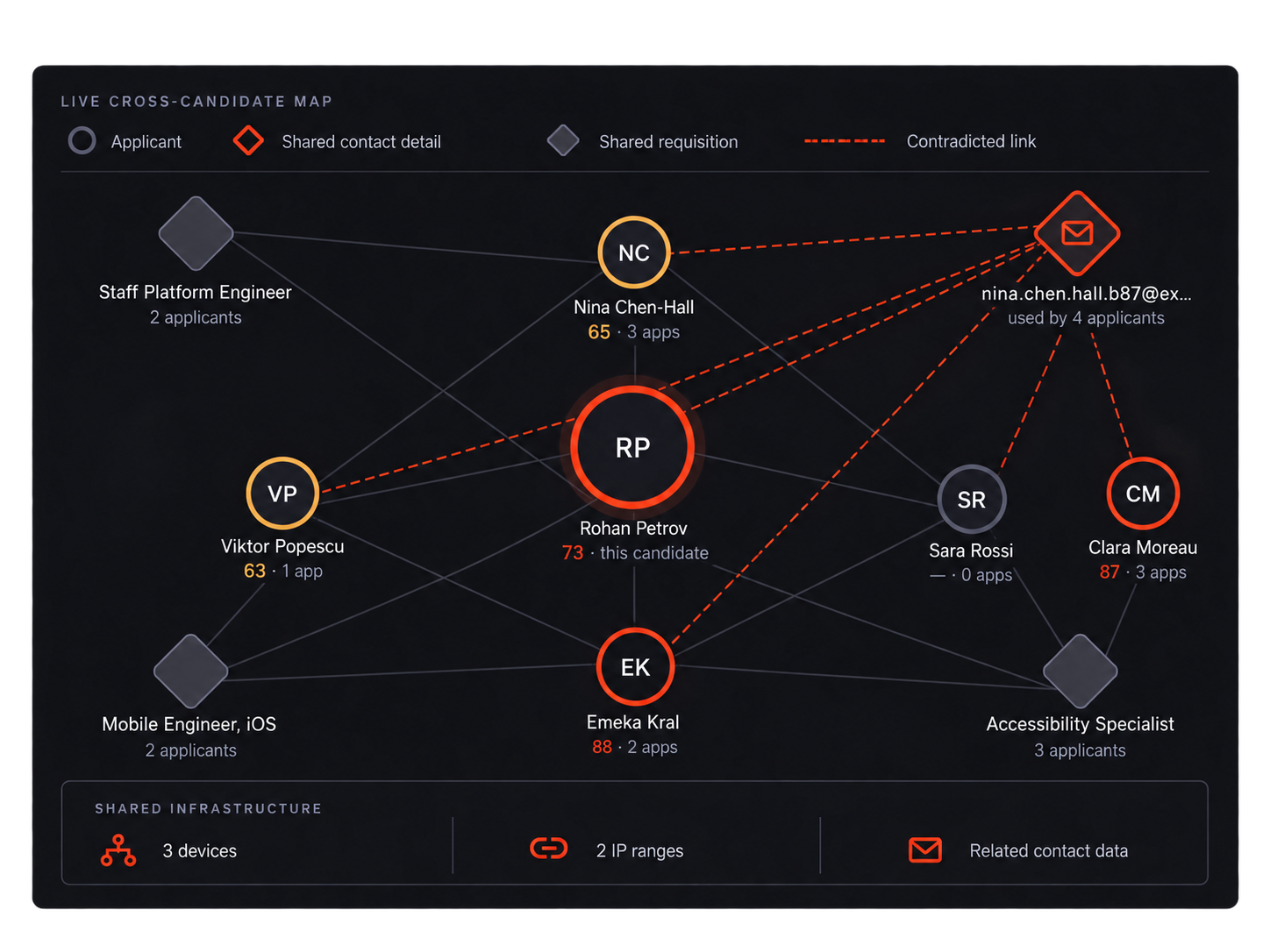
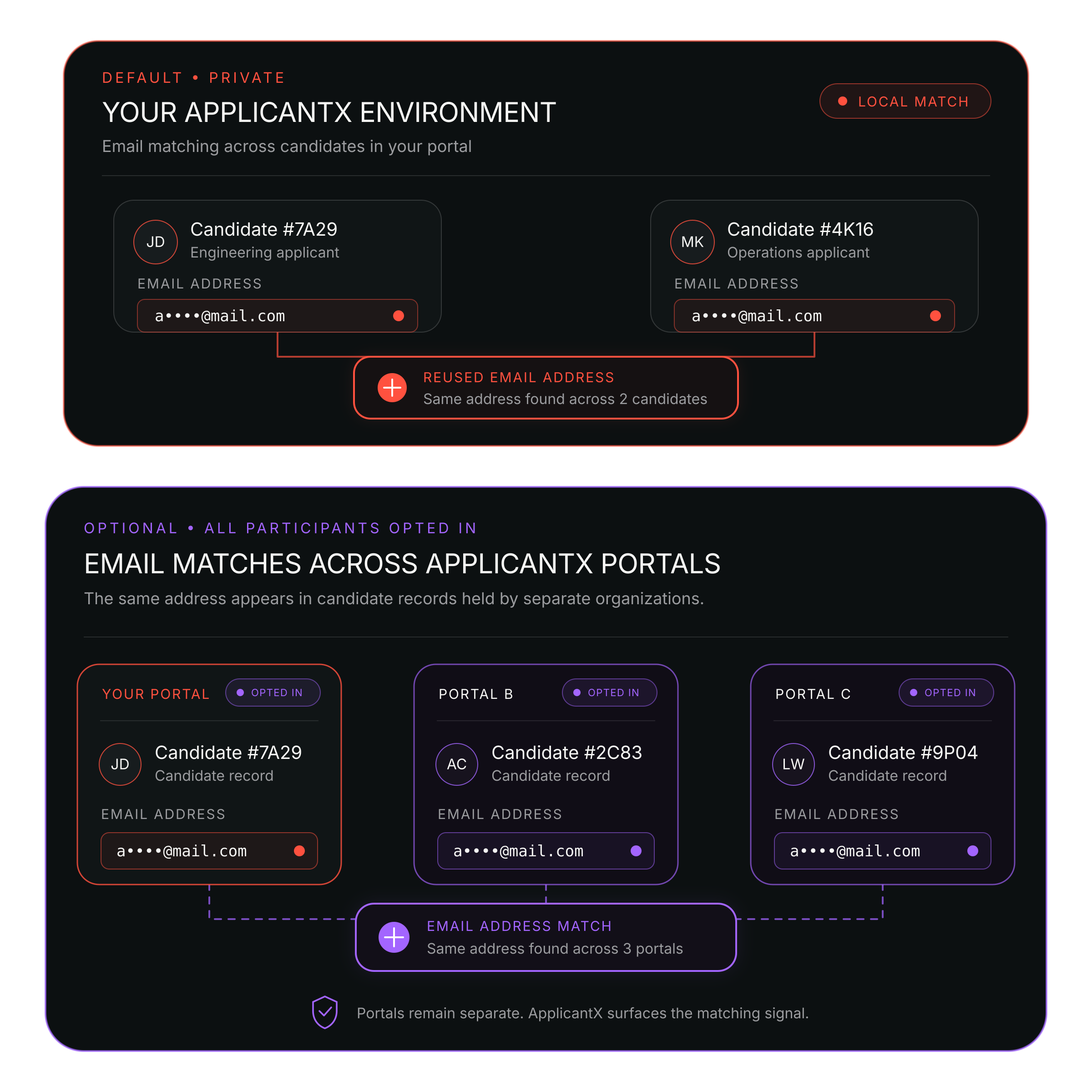
Compares candidates to identify repeated devices, contact details, infrastructure, and patterns within your environment or the opt-in network.
A moment can look legitimate on its own. ApplicantX keeps checking whether the candidate’s information and identity remain consistent as hiring progresses.
Connect shared identities, devices, networks, and tactics to reveal the broader pattern behind one suspicious applicant.
Link seemingly unrelated applicants through shared signals.
Surface the devices, identities, and networks behind the activity.
Recognize related patterns when they appear again.
Fraud rings reuse infrastructure because creating new identities, devices, accounts, and digital artifacts takes effort. ApplicantX recognizes those relationships—first within your environment and, when you choose to participate, across the ApplicantX Network.
The broader ring becomes available only when an organization chooses to participate.
3 connected findings contributed to this assessment.
ApplicantX shows what was detected, which signals contributed, how they relate, and why the applicant was surfaced for review.
Use ApplicantX as a centralized review environment or embed relevant signals and assessments into established hiring workflows.
A centralized environment for fraud detection, monitoring, investigation, and review.
Bring fraud signals and assessments into existing hiring systems and workflows.
ApplicantX connects fraud-related signals into an explainable assessment, then leaves investigation and action in human hands.
Evaluate signals generated throughout the hiring lifecycle.
Identify inconsistencies, anomalies, repeated artifacts, and cross-candidate patterns.
Translate relevant findings into an explainable Fraud Suspicion Rating.
Let your organization review, route, escalate, or resolve the applicant within its workflow.
ApplicantX surfaces potential fraud for review. Your organization decides what happens next.
ApplicantX is the hiring fraud defense technology within the Brilliant company portfolio.